
Friday, May 13, 2016

Thursday, May 5, 2016
BUF Planning Tools and Support
This link will provide you with the tools you need to think about, plan and deeper your knowledge around BUFS.
BUFS are units for language acquisition, content inquiry and literacy. They run concurrently with your CLM units to ensure that students are accessing paired literacy found to be critical in meeting the goals of Bilingualism and Biliteracy, Academic Achievement and Global Competency.
BUFS are unique and feature qualities and shifts in learning that are not represented the same way throughout the curriculum.
Here are some key shifts:
Disciplinary Literacy-----in BUFS----Disciplinary Literacy for Biliteracy Transfer
Essential questions-------in BUFS are------Debatable, arguable essential questions of Global relevance
Learning to read and write--------in BUFS are-----Learning language for transfer to literacy
Guided Reading---------------in BUFS is--------Strategic Inquiry Reading
Leveled Reading------in BUFS is------- Read and Write on Grade level with scaffolds
This link contains much of the work done this year to develop the framework that your coaches are developing with the Bilingual Department and C&I Coordinators.
https://docs.google.com/a/waukesha.k12.wi.us/document/d/1nM2-F15FizMRRx_z_X6FyyBwbWHbu0AOB3h8v6S_ZP8/edit?usp=sharing
DL Instructional Practice of the Week
Total Physical Response in Math
by Martha Smilanich
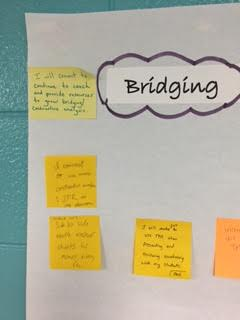
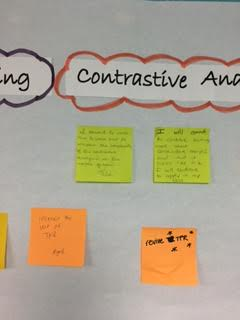
In March the Heyer Elementary dual language teachers gathered to learn more about how to grow the Bridging / Contrastive Analysis. We developed an “I commit” poster as part of that meeting.
Most of us agree that the use of the TPR is a key strategy at all levels.
TPR is used to introduce and make many academic concepts comprehensible. Each key vocabulary word or concept is represented by a gesture or a pantomime, allowing students to associate new information with a picture, image or words and an action. It requires little in the way of productive language (speaking or writing) by the students.
Following up on our meeting this month, we are proposing to create a Universal TPR for DL Math. We need your help and suggestions for achieving our purpose:
Here we present our suggestions.
If you are using something different and want to share with us, please do not hesitate to contact Martha Smilanich or Jamie Martinson.
Thursday, April 21, 2016
The Importance of 4K Bilingual Education for English Learners
Enjoy
CCSS Spanish-Wide Reading Across Genres


Wide Reading Part Two:
The books shown above all deal with the topic of "the other", and differences and how to classify things and people in ways that "make intuitive" sense. In Tili y el muro by Leo Lioni, all of the rats are afraid of what is on the other side of the wall. As a result of hearing how terrible it is, and how the "other" is different and thus wrong or worse, Tili becomes curious and decides to go over the wall. La otra orilla is another text with a similar story line. A mother tells her daughter not to go across the water because different and "other" people live over there. The girl does go across the water, makes a friend and learns about humanity, joining her village to her new friend'svillage. The book, Pero, ?Donde esta ornicar? is about trying to classify a platapus (un ornicorico) because he is a mammal who lays eggs, he is neither like a bird nor like a mammal, so where does he fit? Finally the book "No te metas conmigo" talks about bullying at school and using differences not as strengths but as sources for division and misunderstanding.
Students, a traves de estos libros, can develop a sense of purpose behind our need to classify ourselves into groups of like and different, as well as our unity as living things, and as humanity.
All of these books are in your CCSS collection in your library. Ask Marlene at Banting how she plans to use them :)
D
Subscribe to:
Posts (Atom)